Bitcoin in the Media: 2025 Year-End Report
Comprehensive narrative intelligence analysis from 356,423 data points and 653 sources

Note: This report was originally developed as part of Epoch VC’s “THE BITCOIN ECOSYSTEM” 2026 annual report.
Executive Summary
Bitcoin's media landscape is fractured. Conference attendees live in a world where Bitcoin is winning. Wall Street Journal readers live in a world where Bitcoin is problematic. Both are confident they understand reality. Both are wrong about the other's.
This report maps the gap.
Prepared by Perception, this analysis covers 356,423 datapoints across 653 sources from January 1 to December 30, 2025. Unlike traditional media monitoring that tracks volume, we focus on sentiment structure and narrative patterns, the second-order signals that reveal where perception is heading and why it matters for anyone building, investing, or communicating in this space.
Ten Findings That Matter
- The obituary era has ended. "Bitcoin is dead" is dead. FUD has evolved from existential threats to institutional and legal framing.
- FUD volume is constant, only the topics rotate. Overall negative sentiment remained stable at 12-18% all year. Crime & Legal surged +277% while Environmental collapsed -41%. The attack surface shifted, the total volume didn't.
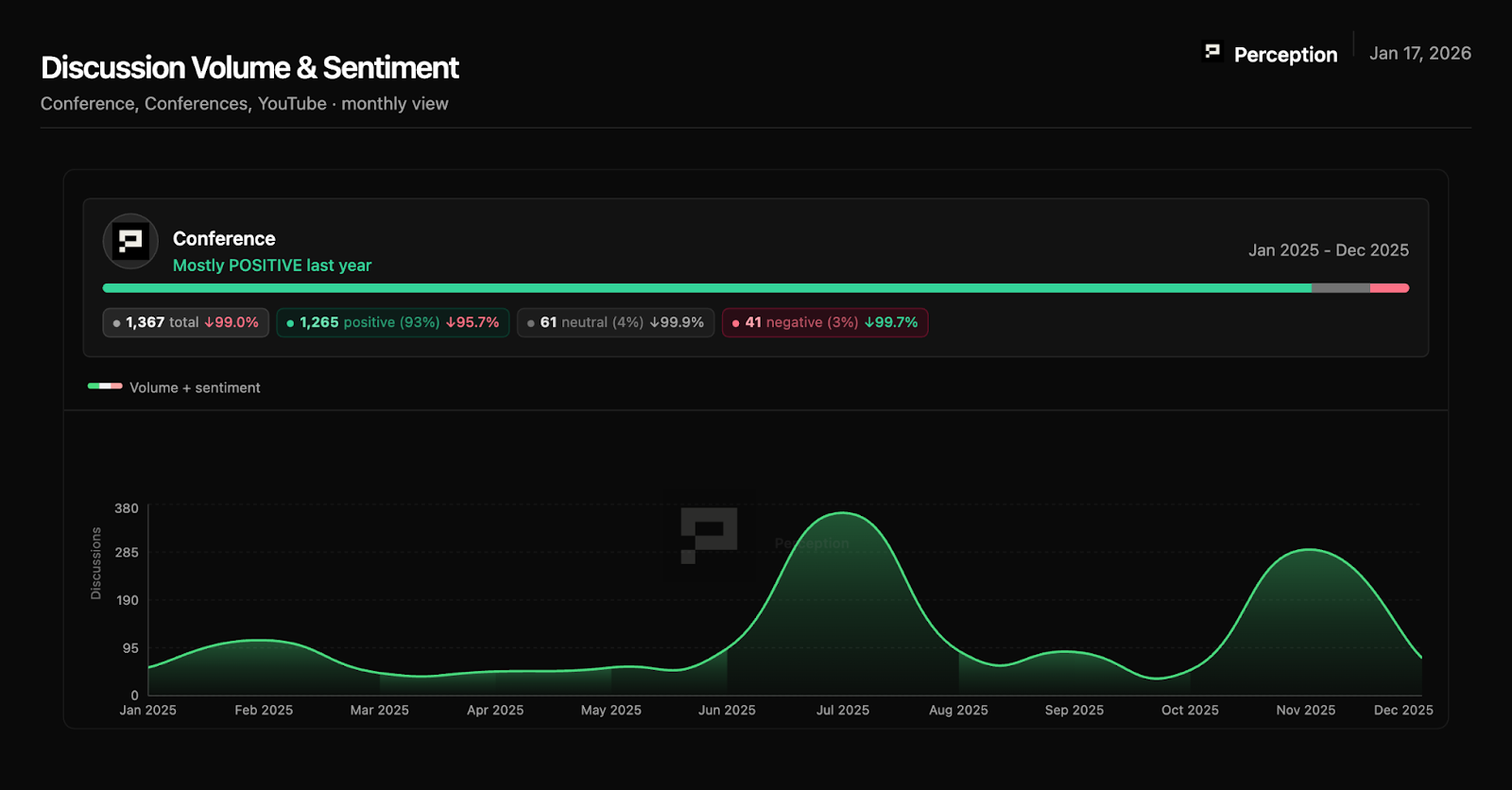
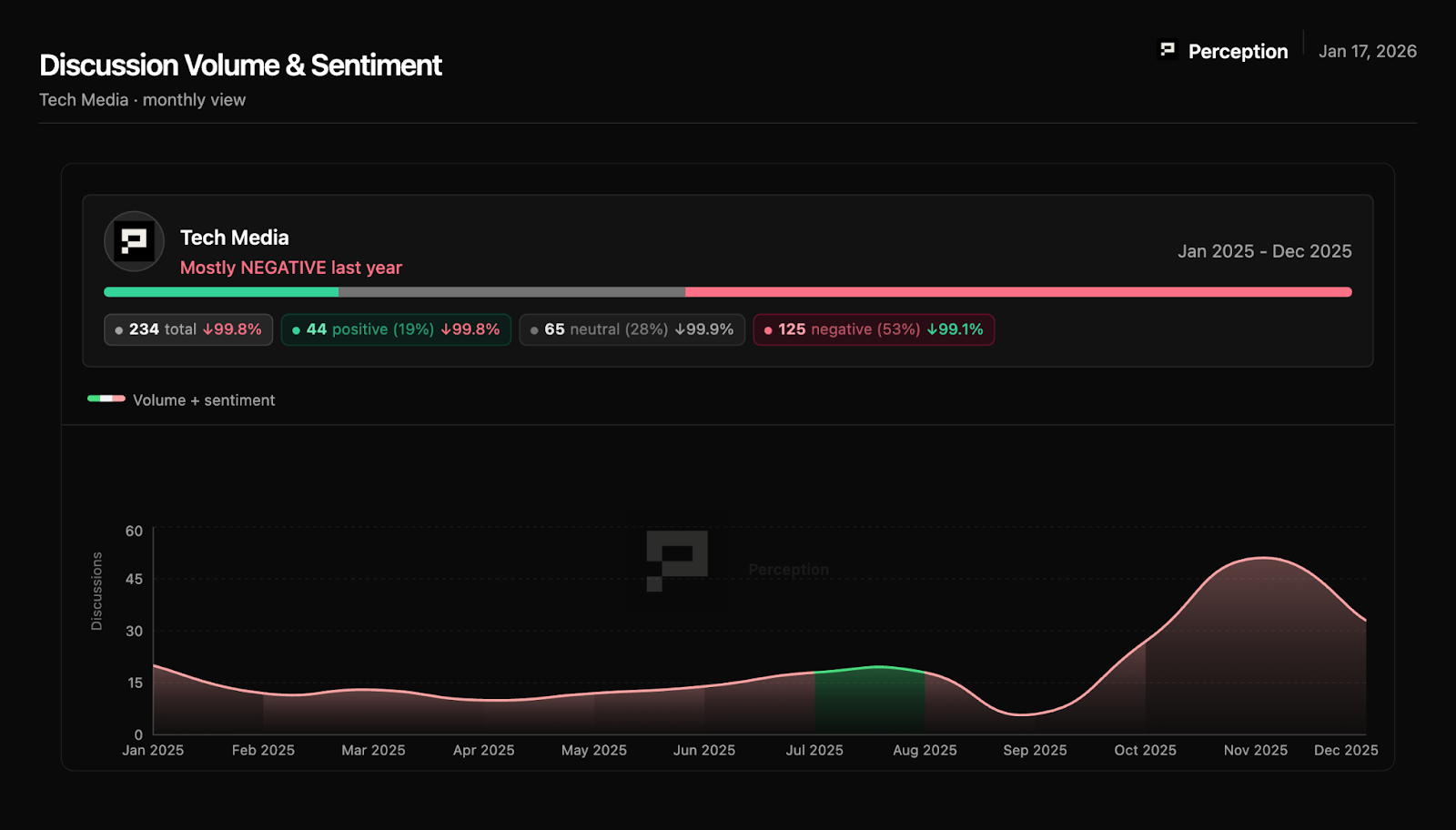
- A 125-point perception gap separates professional audiences. Conference attendees live in a +90 net positive sentiment world. Tech Media readers see -35 net negative sentiment. Opposite realities.
- UK media is structurally hostile. BBC, Daily Mail, and The Guardian run 56-64% negative, about 2-3x more negative than comparable international press. This is editorial positioning.
- Lightning dominates L2 coverage but exists on a perception island. 33% of podcast content discusses Lightning. 0.28% of mainstream media does. A 119x gap.
- Bitcoin's L2 landscape isn't a zero-sum battle. Lightning dominates as incumbent (58%). Ark is the breakout story (24% of mentions, 154% growth). Ecash holds steady. Different protocols, different trajectories, different audiences.
- Mining sentiment swings 67 points based purely on framing. Mainstream covers mining at 75.6% positive. Communities discuss it at 8.4% positive.
- Strategic Reserve collapsed 70 points from June to December. The narrative peaked at 96.3% positive. By December: 26.7% positive. Implementation skepticism replaced proposal enthusiasm.
- Mainstream media coverage was 41% more negative in 2025 than 2024. Institutional adoption up, media sentiment down. The gap keeps widening.
- Q4 shows maximum sentiment divergence. A 50-point gap emerged between Social Media (+24.9) and Mainstream Media (-25.3). When retail enthusiasm disconnects this sharply from institutional narratives, volatility historically follows.
How to Read This Report
The Core Measurements
The 12-18% Range
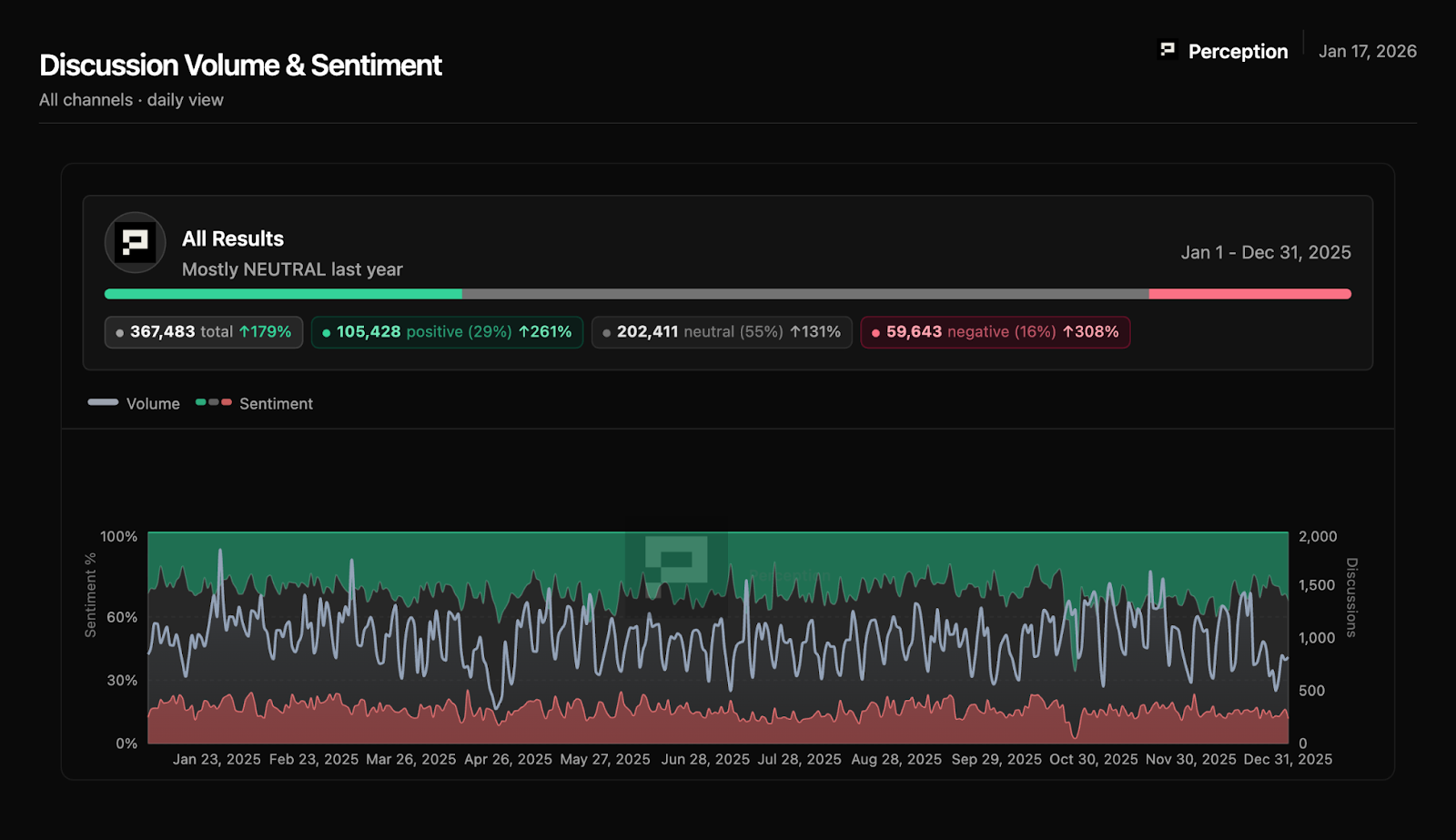
When we say "negative coverage stayed between 12-18% all year," this measures the share of ALL Bitcoin mentions carrying negative sentiment. The stability of this range is the insight. FUD volume is constant, but topics rotate.
Data Integrity
This analysis draws from 653 sources selected and weighted by practitioners with years of experience in Bitcoin media. Unlike generic monitoring tools that scrape keywords across the entire internet, Perception's source list is curated for signal quality:
Sentiment classification uses a combination of proprietary analysis systems and human validation on edge cases. Full methodology documentation available at [perception.to/methodology].
Part I: The Sentiment Landscape
The 125-Point Perception Gap
BOTTOM LINE: Where you get your Bitcoin news determines what you believe about Bitcoin. Conference attendees and Tech Media readers have completely opposite views of the same asset, and most professionals find themselves in a narrative bubble.
A founder who attends Bitcoin Amsterdam and reads Bitcoin Magazine believes the world is coming around.
A pension fund analyst who reads WSJ and BBC believes Bitcoin remains problematic.
They're both confident in their assessment but they're both wrong about the other's reality.
This 125-point perception gap is the most underappreciated risk in Bitcoin communications.
The implication:
Those attending conferences and reading Bitcoin Magazine live in a +90 world. They assume mainstream sentiment is improving because their sentiment is improving.
Meanwhile, the marginal new investor is reading Yahoo Finance (-16), WSJ (-40), or BBC (-57).
Content and messaging that bridges these worlds represents a significant opportunity, but requires acknowledging they exist as separate realities first.
UK Media: The Skeptics' Stronghold
BOTTOM LINE: British media runs 2-3x more negative on Bitcoin than comparable international press. This is structural and not story-dependent. Adjust expectations accordingly.
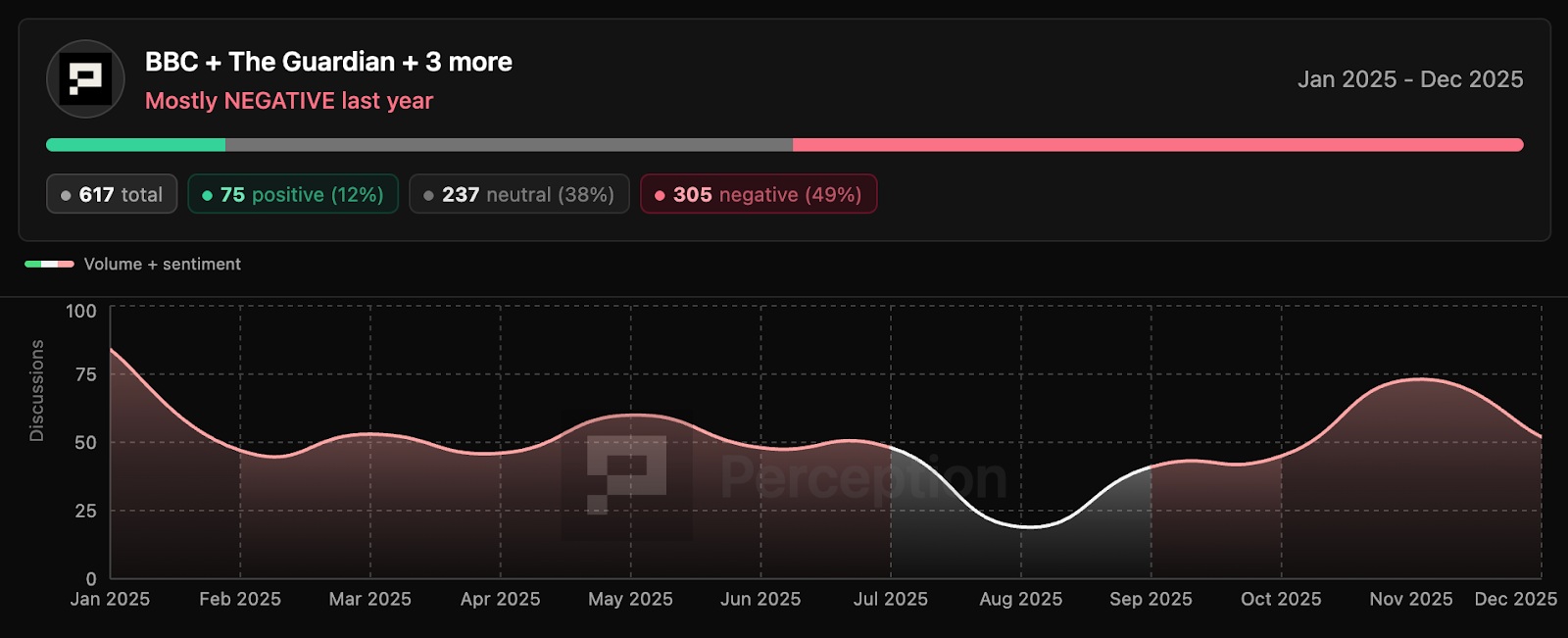
Geographic analysis reveals UK media as the most hostile English-language bloc:
The pattern follows a clear hierarchy: tabloids most negative (63.8%), legacy broadcasters close behind (62.5%), quality broadsheets moderate (44-56%), business press approaching neutral (28.8%), and wire services the only UK source with positive net sentiment.
Q4 Channel Divergence
BOTTOM LINE: By Q4 2025, a 50-point gap opened between where retail gets information (Social Media: +24.9) and where institutions get information (Mainstream Media: -25.3). This divergence historically precedes significant volatility. Either mainstream catches up, or retail corrects.
November was peak divergence at nearly 60 points, coinciding with BTC crossing $100K.
When retail enthusiasm disconnects this sharply from institutional narratives, it historically precedes one of two outcomes: mainstream catches up, or retail corrects. Either way, 2026 will likely resolve this gap.
What does this mean for the year ahead? We break down three scenarios and the leading indicators to watch in Part V: 2026 Outlook.
Part II: The FUD Evolution
"Bitcoin is Dead" is Dead
BOTTOM LINE: Critics have conceded Bitcoin's existence. They now attack its price, not its legitimacy. Crash language (852 mentions) is 2x more common than existential language (428 mentions).
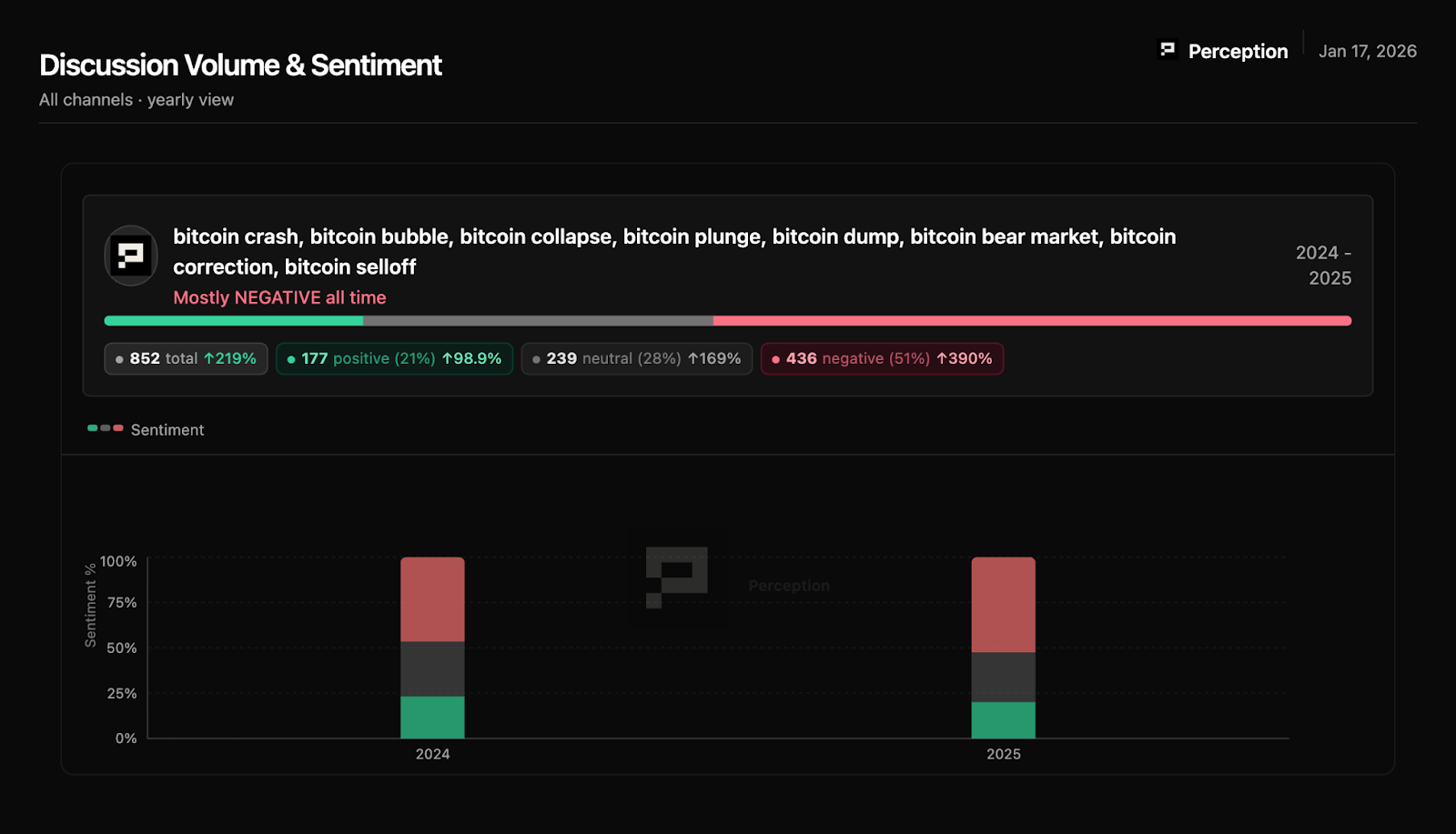
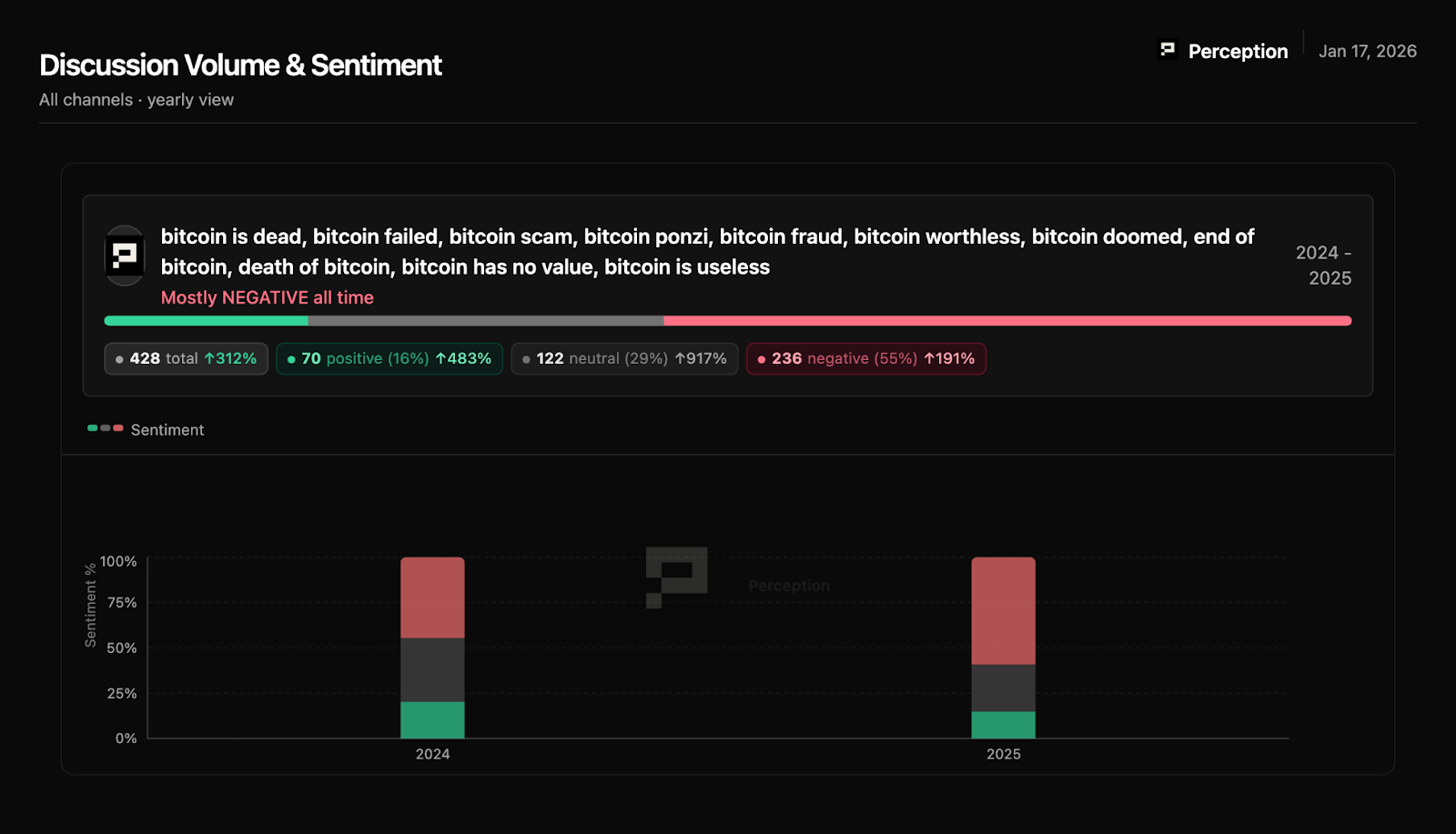
We tracked two categories of negative framing:
Existential language (attacks on Bitcoin's legitimacy): "bitcoin is dead," "scam," "ponzi," "fraud," "worthless," "doomed," "useless"
- 428 mentions
- 55% negative
Crash language (attacks on Bitcoin's price): "crash," "bubble," "collapse," "plunge," "dump," "bear market," "correction," "selloff"
- 852 mentions
- 51% negative
The shift:
Critics used to say Bitcoin was a scam that would disappear. Now they say Bitcoin will crash.
That's a fundamental concession. They've stopped arguing Bitcoin shouldn't exist. They're just betting against its price. The attack moved from existential to financial.
The FUD Metamorphosis
BOTTOM LINE: FUD isn't declining. It's shape-shifting. Total negative sentiment stayed flat across all channels at 12-18% all year. Only the topics carrying that negativity rotated as each became untenable.
The common assumption is that Bitcoin FUD is declining as the asset matures. The data tells a different story: total negative mention volume remained stable at 12-18% all year, but the composition shifted dramatically.
The Predetermined Frame Pattern
BOTTOM LINE: When coverage on a topic runs 99.6% negative, we're observing an editorial position seeking evidence instead of journalism discovering a story. Understanding predetermined frames changes how you respond to media.
When Mainstream Media covered Crime & Legal topics in 2025, 99.6% of coverage was negative. Only 0.4% positive.
For context: even highly contested topics typically show 10-20% dissent in coverage. Complete consensus (99%+) is not organic discovery. It's predetermined framing.
How predetermined frames work:
- An editorial position exists ("Bitcoin enables crime")
- Stories are selected and framed to support this position
- Counter-evidence is ignored or minimized
- The frame appears "objective" because it's consistent across stories
Why this matters:
Predetermined frames don't respond to evidence. Environmental FUD declined only after years of renewable mining data made the talking points untenable. Crime & Legal is the current vehicle precisely because it's harder to disprove.
Environmental claims can be countered with energy mix data. "Bitcoin is dead" gets disproven every time the price recovers. But "Bitcoin enables crime" only requires one example to reinforce, and no amount of legitimate use cases can definitively prove criminals don't use it.
The topic rotation pattern:
The data reveals what appears to be a constant "negativity budget" in mainstream coverage. When one attack vector loses credibility, another rises to fill the gap:
- Environmental FUD peaked, then renewable mining data proliferated, then volume dropped 41%
- "Bitcoin is dead" became a meme, credibility collapsed, only 52 mentions all year
- Crime & Legal emerged, harder to counter with data, volume rose 277%
The total negativity stays flat. The vehicle changes.
Strategic implication:
Don't try to "win" coverage in predetermined-frame outlets by providing better evidence. The frame precedes the evidence. Instead:
- Accept that some outlets have structural positions
- Focus resources on outlets with genuine editorial openness
- Build direct channels that bypass predetermined frames entirely
Rising FUD: Crime & Legal (+277%)
BOTTOM LINE: Crime & Legal is the dominant FUD narrative of 2025 and will likely persist into 2026. It's strategically chosen: harder to disprove with data, carries regulatory tailwinds, and resonates with institutional gatekeepers.
What Crime & Legal covers:
This category captures coverage that frames Bitcoin primarily through its association with illicit activity. The main narratives include:
- Money laundering and sanctions evasion
- Ransomware payments
- Dark web transactions
- Fraud and scams involving Bitcoin
- Terrorist financing concerns
- Regulatory enforcement actions
Volume increased from 222 mentions in January to 838 in November. November intensity hit 91.1% negative, near-total negativity.
When Mainstream Media covered Crime & Legal, 99.6% of coverage was negative.
Why this vector was chosen:
- Environmental FUD got countered by renewable mining data
- "Bitcoin is dead" became a meme that undermined credibility
- Crime & Legal is harder to disprove. You can't prove Bitcoin doesn't enable crime
- Regulatory tailwinds (AML/KYC debates) provide ongoing story hooks
- Resonates with institutional gatekeepers who need "risk" justifications
What to expect in 2026:
Crime & Legal will remain the primary FUD vehicle until either:
- A major regulatory clarity event removes the ambiguity
- The narrative becomes as obviously untenable as "Bitcoin is dead"
- A new attack vector emerges that better serves editorial needs
None of these appear imminent.
Shrinking FUD: Environmental (-41%)
BOTTOM LINE: Environmental FUD lost its teeth in 2025. Volume dropped 41%, intensity collapsed from 11.3% to 3.8% negative. The renewable mining data won.
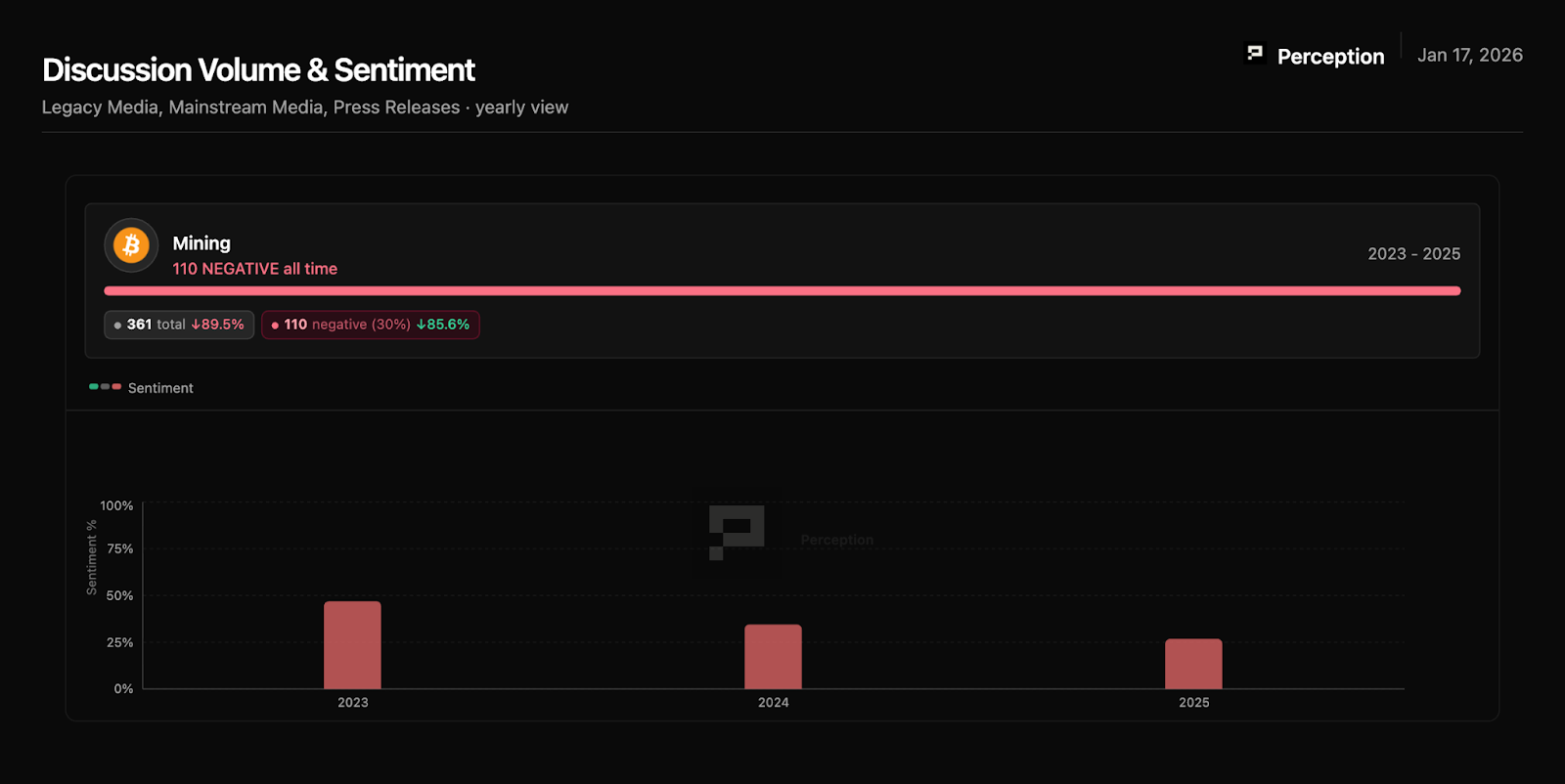
This is what successful counter-narrative looks like:
- Renewable mining data proliferated and became undeniable
- Old talking points got debunked repeatedly
- The narrative became increasingly difficult to sustain
The lesson:
FUD can be defeated, but it requires:
- Sustained, evidence-based counter-messaging over years
- Industry coordination on data transparency
- The attack vector becoming embarrassing for outlets to repeat
Environmental FUD took 3+ years to neutralize. Crime & Legal is earlier in this cycle.
Quantum FUD: A Self-Inflicted Wound
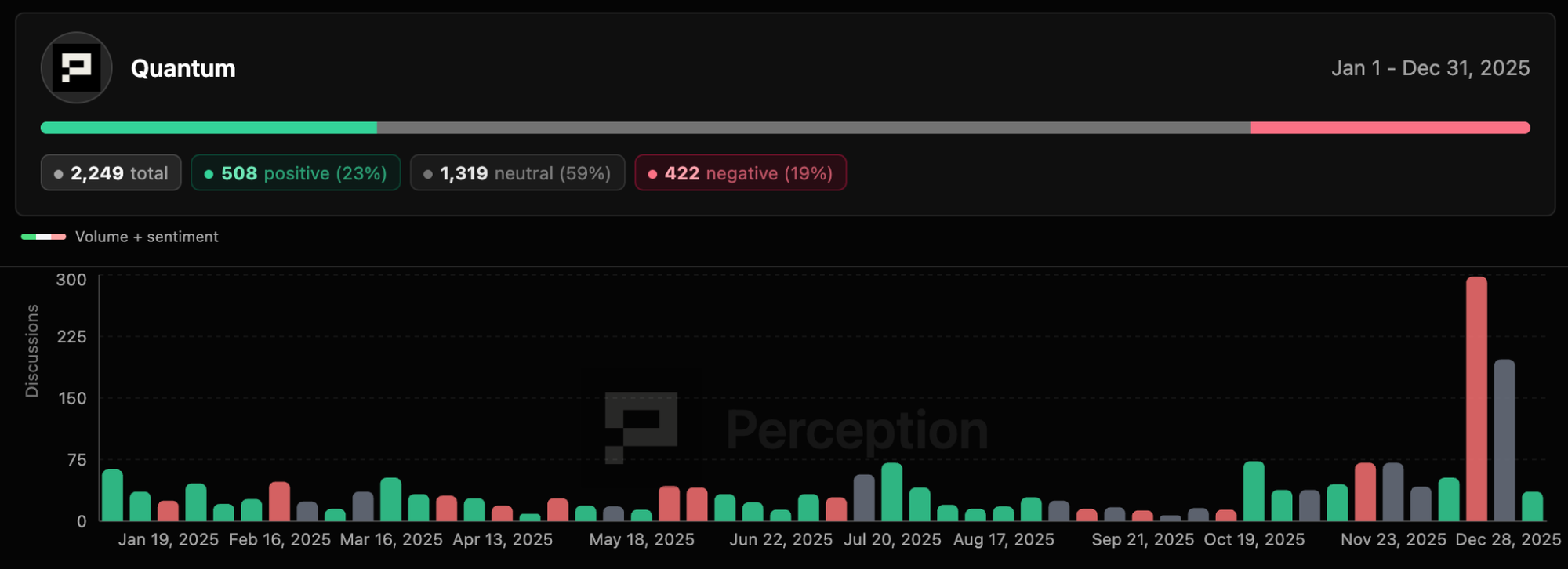
BOTTOM LINE: Quantum computing FUD wasn't a mainstream media attack. It was self-generated within crypto. We shot ourselves in the foot.
Social Media: 1,035 mentions (53.4% of quantum coverage). Mainstream Media: Only 17 mentions (0.9%).
If quantum FUD impacted price or sentiment, it was NOT because mainstream media scared retail investors. It was crypto-native social media creating an internal fear cycle that financial media then amplified in Q4.
The pattern:
- Technical discussion started in crypto communities
- Social media amplified concerns without context
- Fear cycle went viral within crypto
- Financial media noticed the internal panic and covered it
- Mainstream media barely registered it
The lesson:
Not all FUD comes from outside. Internal fear cycles can be more damaging than external attacks because they're harder to counter. You're arguing with your own community.
Part III: Layer 2 & Scaling Coverage
How Media Covers Bitcoin's Scaling Solutions
BOTTOM LINE: Lightning dominates coverage but exists on a "perception island," huge in podcasts and crypto media, nearly invisible in mainstream. The L2 landscape isn't zero-sum, but attention and sentiment follow different rules for each protocol.
The storylines:
- Lightning: The incumbent. Dominates volume (58%) with balanced sentiment. Steady, established, but not growing share.
- Ark: The breakout. Mentions grew 154% from January to November. But growth came with friction. Highest negative sentiment at 17%. Rapid ascent sparks debate.
- Ecash protocols: The technical discussion. 77% neutral sentiment suggests muted, technical coverage without strong takes. Flying under the radar.
- Liquid Network: The quiet achiever. Just 0.8% of coverage but highest positive sentiment (55%). Small devoted following while the broader conversation moved elsewhere.
Volume and perception are different games. Winning one doesn't guarantee the other.
The Perception Island Problem
BOTTOM LINE: Lightning gets 33% of podcast coverage but 0.28% of mainstream coverage, a 119x gap. Don't expect media to drive Lightning adoption. The awareness paths are completely disconnected.
What this means for Lightning:
- Don't expect media to drive narrative momentum
- Conference enthusiasm does not equal market awareness
- Alternative go-to-market narratives are essential
Founder Insight: The "Layer 2" Label Is a Go-to-Market Trap
BOTTOM LINE: Mainstream media doesn't understand "Layer 2" and doesn't try to. Founders positioning as "L2 infrastructure" are invisible to the audiences that drive adoption. Position as the application, not the architecture layer.
The 119x coverage gap between podcasts and mainstream is a framing problem and trying to call it a media failure is just a way to not face the problem.
What mainstream understands:
- "Instant Bitcoin payments" (payments narrative)
- "$0.001 remittances to El Salvador" (remittances narrative)
- "In-game Bitcoin rewards" (gaming narrative)
- "Bitcoin that works like Venmo" (consumer narrative)
What mainstream doesn't understand:
- "Layer 2 scaling solution"
- "Payment channel network"
- "Off-chain transaction protocol"
The reframe:
Stop positioning as infrastructure. Position as the application that infrastructure enables.
The tech press will find your L2 architecture interesting. They'll write about payment channels and routing algorithms. But tech press reaches developers, not users.
Mainstream reaches users. And mainstream needs use cases, not architecture.
Tactical application:
The technical accuracy matters for developers. The use-case framing matters for everyone else.
Part IV: Topic Deep Dives
Mining: The 67-Point Framing Swing
BOTTOM LINE: Mining sentiment varies 67 points depending on who's covering it. Mainstream sees corporate success stories (+67.4). Communities see centralization concerns (-3.8). Mining companies need dual-track communications to address both realities.
Mainstream Media (75.6% positive) vs. Communities (8.4% positive) = 67.2-point gap.
The framing difference:
Neither is wrong. They're answering different questions. One asks "Is this a good business?" The other asks "Is this good for Bitcoin?"
Why Community Credibility Matters for Mining Companies
BOTTOM LINE: Mining companies are winning institutional narratives (+67.4) while losing community trust (-3.8). The institutional wins are priced in. The community credibility gap is the underexploited opportunity.
Marathon (MARA) sponsors development of BIP 360, which may benefit their Anduro sidechain. This is strategic positioning.
Community credibility translates to:
- Developer talent acquisition: Engineers want to work for companies the community respects. The best Bitcoin developers have options. They choose employers based on public perception and reputation, not just compensation.
- Protocol influence: Companies with community trust get seats at technical discussions. When consensus changes are debated, community-credible companies have voice. Others are viewed with suspicion.
- Retail shareholder base: Bitcoin-native retail investors disproportionately hold mining stocks. Community sentiment directly impacts a meaningful portion of the shareholder base.
- Partnership opportunities: Bitcoin-native companies prefer working with community-credible partners. Protocol teams, wallet developers, and infrastructure projects choose collaborators based on reputation.
- Narrative resilience: When FUD hits (and it will), community-credible companies have defenders. Others face criticism from both outside AND inside.
The opportunity:
The 67-point sentiment gap means mining companies are optimized for mainstream narratives while underinvesting in community credibility. The mainstream wins are priced in. The community credibility gap is where differentiation lives.
Strategic Reserve: The 70-Point Collapse
BOTTOM LINE: The "Strategic Bitcoin Reserve" narrative has peaked. Sentiment collapsed 70 points from June to December as proposal enthusiasm gave way to implementation skepticism. Companies still positioning around government adoption are riding a stale narrative.
The narrative lifecycle:
- Proposal Enthusiasm (Q1-Q2): "What if governments held Bitcoin?" Pure speculation and maximum optimism.
- Mainstream Validation (Q2): Major outlets covered the concept seriously. Peak sentiment.
- Implementation Reality (Q3): Details emerged. Custody questions. Political feasibility. Regulatory complexity.
- Skepticism (Q4): "This is harder than it sounded." Crypto-native outlets turned critical as enthusiasm met reality.
Strategic implication:
Strategic Reserve as a narrative tailwind has peaked. Companies that positioned around government adoption narratives need to pivot messaging toward:
- Private institutional adoption (treasury strategies, ETF flows)
- Self-sovereign use cases (individual holdings, inheritance planning)
- Corporate adoption (MicroStrategy model, balance sheet allocation)
Government adoption may still happen. But the narrative has moved from "exciting possibility" to "complex implementation." The tailwind is gone.
Mainstream Media Got Worse, Not Better
BOTTOM LINE: Mainstream media coverage was 41% more negative in 2025 than 2024 despite institutional adoption, ETF success, and record prices. The return on mainstream media effort has declined.
ETF approvals didn't help. Corporate adoption didn't help. Record prices didn't help. Mainstream outlets are entrenched.
The math has changed:
What "higher effort, lower return" means:
Getting a Bitcoin story placed in the Wall Street Journal or CNBC used to be worth significant effort. The credibility and reach justified the work. In 2025, that same effort yields coverage that's 41% more likely to be negative.
You're working harder for worse outcomes.
The alternative channels:
The recommendation:
Don't abandon mainstream, but recalibrate expectations. Mainstream placement is now primarily a credibility signal ("as covered in WSJ") rather than a distribution channel. The actual audience building happens elsewhere.
For most Bitcoin companies, resources are better spent on:
- Crypto-native outlets (higher hit rate, better framing)
- Financial trade press (neutral framing, institutional audience)
- Direct channels (complete control, engaged audience)
Part V: 2026 Outlook
BOTTOM LINE: The 50-point Q4 divergence between retail and institutional sentiment will resolve in 2026. Either mainstream catches up, retail corrects, or the gap persists and traditional cycle dynamics weaken. Each scenario has different implications.
The Divergence Must Resolve
By December 2025, Social Media sentiment sat at +24.9 while Mainstream Media sat at -25.3. A 50-point gap.
Historically, gaps this wide don't persist. They resolve in one of three ways:
Scenario 1: Mainstream Catches Up (Bullish)
What happens: Institutional coverage turns neutral-to-positive. The 50-point gap closes upward as mainstream sentiment follows retail enthusiasm.
Historical pattern: When mainstream sentiment follows retail enthusiasm, price tends to consolidate at higher levels rather than retrace. The narrative catches up to the price.
What to watch:
- Mainstream negative coverage dropping below 30% (currently 44.5%)
- Financial media turning net positive (currently -2.8)
- Crime & Legal intensity declining without a replacement FUD vector
Probability: Moderate. Requires either a major positive catalyst (global regulatory clarity, major corporate adoption) or simple exhaustion of negative narratives.
Scenario 2: Retail Corrects (Bearish)
What happens: Social media enthusiasm proves unsustainable. The gap closes downward as retail sentiment capitulates toward institutional skepticism.
Historical pattern: Sharp sentiment corrections in retail channels often precede or coincide with 20-30% drawdowns. Retail enthusiasm without institutional validation is fragile.
What to watch:
- Social media net sentiment dropping below +10 (currently +24.9)
- Community sentiment turning negative (currently +3.3)
- Crypto media sentiment declining further (dropped 7.6 points Q3 to Q4)
Probability: Moderate. The retail enthusiasm of Q4 2025 hasn't been validated by institutional sentiment shifting.
Scenario 3: Divergence Persists (Cycle Structure Weakening)
What happens: The gap neither closes nor triggers correction. Retail and institutional markets increasingly operate on different information, different timelines, and different logic.
Implication: "The cycle" as a predictive framework may be losing utility. If retail and institutional sentiment can diverge 50+ points without resolution, traditional cycle dynamics are weakening.
What to watch:
- Gap persisting above 40 points through Q1 2026
- Different sentiment channels moving independently (not correlated)
- Price action disconnecting from sentiment patterns
Probability: Lower, but would be the most significant structural finding. Would suggest Bitcoin markets are fragmenting into separate retail and institutional dynamics.
The FUD Forecast
Crime & Legal: Will remain the dominant FUD vector through at least H1 2026. No obvious replacement narrative has emerged, and regulatory tailwinds continue.
Quantum: Likely fades. The self-inflicted nature became apparent, and mainstream never picked it up meaningfully.
Environmental: Stays suppressed. The counter-narrative won.
New vectors to watch:
- Centralization concerns (ETF concentration, mining consolidation)
- Custody risks (institutional custody failures, exchange issues)
- Protocol ossification (governance debates, development pace)
What to Watch: The Leading Indicators
Strategic Actions
1. Run Parallel Marketing Tracks
The finding: 125-point perception gap between conference (+90) and mainstream (-35) audiences.
The risk: Single-message strategies fail. What resonates with conference attendees alienates mainstream. What satisfies mainstream sounds defensive to Bitcoiners.
The action:
The test: Before any major announcement, ask: "Does this message work for someone who reads Bitcoin Magazine AND someone who reads the Wall Street Journal?" If it only works for one, you need two versions.
2. Prepare for Crime & Legal FUD
The finding: +277% volume increase, 91.1% negative intensity in November.
The risk: 2026 will see continued crime/regulation framing as the primary attack vector.
The action:
- Develop proactive compliance narratives before they're needed
- Create educational content on tradeoffs (privacy vs. transparency, self-custody vs. regulation)
- Build relationships with reporters who cover the nuance, not just the headline
- Prepare response templates for common crime-framing stories
3. Accept Lightning's Perception Island
The finding: 33% of podcasts cover Lightning, 0.28% of mainstream does, a 119x gap.
The risk: Expecting media to drive Lightning adoption will disappoint.
The action:
- Build go-to-market narratives around use cases, not architecture
- Focus resources on direct channels (podcasts, community, developer relations)
- When seeking mainstream coverage, pitch applications ("instant payments") not infrastructure ("Layer 2")
4. Adjust UK Media Strategy
The finding: BBC, Guardian, Daily Mail run 56-64% negative, structural, not story-dependent.
The risk: Standard PR approaches yield negative coverage regardless of news quality.
The action:
- Deprioritize UK tabloids and legacy broadcasters for proactive pitching
- Focus UK efforts on Financial Times and Reuters (more neutral)
- Build direct-to-audience channels for UK market
- Accept that some outlets have predetermined frames
5. Run Dual-Track Mining Communications
The finding: 67-point sentiment swing based on framing (Mainstream +67.4, Community -3.8).
The risk: Institutional wins don't translate to community credibility, and vice versa.
The action:
- Separate communications tracks for institutional and community audiences
- Institutional: earnings, partnerships, ESG compliance, growth metrics
- Community: open-source contributions, decentralization efforts, protocol support
- Invest in community credibility (sponsor development, support open-source, engage technical debates)
6. Rotate Off Strategic Reserve Messaging
The finding: 70-point collapse from June peak, implementation skepticism replaced proposal enthusiasm.
The risk: Positioning around government adoption now sounds stale.
The action:
- Pivot to private institutional adoption narratives (corporate treasury, ETF flows)
- Emphasize self-sovereign use cases
- If covering government adoption, focus on implementation challenges and realistic timelines, not hype
7. Monitor BitVM and Ecash
The finding: BitVM research spike, Ecash conference momentum, potential 2026 narrative shifts.
The risk: L2 landscape may shift faster than expected.
The action:
- Track these protocols for sentiment changes
- Prepare positioning for potential "next Lightning" narratives
- Understand technical differentiation for rapid response
8. Reallocate Mainstream Media Resources
The finding: 41% more negative coverage YoY despite positive fundamentals.
The risk: Continuing to invest heavily in mainstream placement yields declining returns.
The action:
- Treat mainstream placement as credibility signal, not distribution channel
- Shift resources to crypto-native outlets, financial trade press, and direct channels
- Maintain mainstream relationships but calibrate effort to expected (lower) return
- Build owned audience that doesn't depend on editorial gatekeepers
Prepared by Perception Research
This report demonstrates the power of comprehensive narrative intelligence.
356,423 mentions. 653 sources. One year of Bitcoin perception.
Access the underlying data: [perception.to/data]
Full methodology documentation: [perception.to/methodology]
Questions or feedback: [email protected]